


Confira todos os pronomes do inglês: pessoais, possessivos, reflexivos, demonstrativos, interrogativos, recíprocos, indefinidos e relativos.
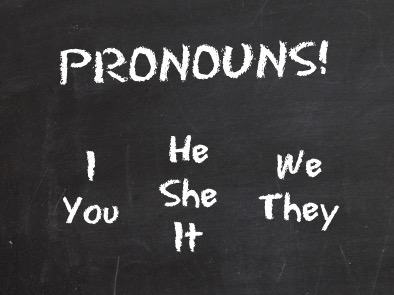
1 – PRONOMES PESSOAIS
a) Pronomes Retos
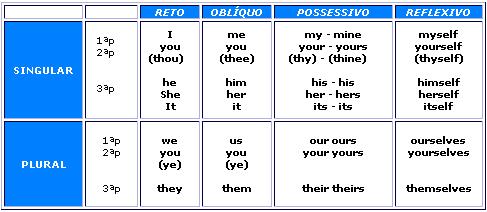
I. O pronome I, eu, é sempre escrito com maiúscula.
Thou, tu, é forma arcaica. O pronome thou só é usado, atualmente, em linguagem poética ou bíblica.
You, a forma usada, equivale a tu, você, o senhor, a senhora.
He, ele, e she, ela, referem-se a pessoas, animais e coisas personificadas.
It, ele ou ela, pronome neutro, refere-se geralmente a coisa. Pode também referir-se a um bebê, quando não é indicado o sexo.
We, nós.
Ye, vós, o plural de thou, é forma absoleta em prosa. A forma usada é you, que corresponde a vós, vocês, os senhores, as senhoras.
They, eles, elas, plural de he, she e it, refere-se a pessoas, animais e coisas.
Os pronomes retos são usados como sujeitos da oração.
Ex.: I wrote two letters, escrevi duas cartas.
He read the letters, ele leu as cartas.
OBSERVAÇÕES: 1ª) Os pronomes retos são também usados como complementos do verbo to be: 2ª) Em linguagem coloquial, é frequente o emprego das formas oblíquas: |
b) Pronomes Oblíquos
As formas me, you (thee), him, her, it, us, you (ye), them são usadas:
1) Como objeto direto:
I saw her yesterday, eu a vi ontem.
She saw us, ela nos viu.
I didn’t see them, não os (as) vi.
2) Como objeto indireto preposicionado:
We looked at him, olhamos para ele.
He waits for us, ele nos espera.
3)Como objeto indireto sem preposição;
We gave them a few books, demos-lhes alguns livros.
I told him all that happened, contei-lhe tudo que aconteceu.
2 – PRONOMES POSSESSIVOS
a) Os pronomes adjetivos my, thy, his, her, its, our, your, their e os pronomes substantivos mine, thine, his, hers, its, ours, yours, theirs correspondem aos pronomes pessoais:
| PRONOMES PESSOAIS | PRONOMES POSSESSIVOS |
I, eu | my, mine, meu, minha, meus, minhas |
b) Os pronomes adjetivos my, thy, etc. antecedem o substantivo:
Where is my pencil? – Onde está meu lápis?
Our books are open. – Nossos livros estão abertos.
c) Os pronomes substantivos mine, thine, etc. são usados quando o substantivo não é expresso:
Whose hat is this? It is mine. – De quem é este chapéu? É meu.
d) Os possessivos concordam em gênero e número com o possuidor e não com a coisa possuída, como em português:
Paul wrote to
| his brother his sister his brothers his sisters | Paulo escreveu a | seu irmão sua irmã seus irmãos suas irmãs |
Mary wrote to
| her brother her sister her brothers her sisters | Maria escreveu a | seu irmão sua irmã seus irmãos suas irmãs |
Paul and Mary wrote to
| their brother their sister their brothers their sisters | Paulo e Maria escreveram a | seu irmão sua irmã seus irmãos suas irmãs |
3 – PRONOMES REFLEXIVOS
a) Pronomes compostos de SELF, SELVES
| Singular | Plural |
| Myself Thyself Himself Herself Itself | ourselves yourselves themselves |
b) Os compostos de self, selves podem ser empregados:
I – Como pronomes reflexivos: He hurt himself, ele se feriu.
II – Como pronomes enfáticos: He read the letter himself, ele próprio fez a caixa.
OBSERVAÇÕES: 2ª) Quando se fala a uma só pessoa, usa-se yourself e não ourselves. 3ª) O pronome enfático pode ser empregado após um verbo intransitivo: |
c) O pronome reflexivo correspondente ao pronome indefinido one, a gente, é oneself: to hurt oneself, ferir-se.
4 – PRONOMES DEMONSTRATIVOS
a) Os demonstrativos:
this, este, esta, isto;
these, estes, estas;
that, esse, essa, isso, aquele, aquela, aquilo; e
those, aqueles, aquelas
São usados:
I) Como pronomes adjetivos:
This boy is writing, este menino está escrevendo.
That girl is reading, aquela menina está lendo.
These books are mine, estes livros são meus.
Those children are playing, aquelas crianças estão brincando.
II) Como pronomes substantivos;
Who is this? Quem é este?
What is this? Que é isto?
These are the books he bought, estes são os livros que ele comprou.
Do you agree to that? Você concorda com isso?
That’s not right, isso não está direito.
We talked of this and that, falamos disto e daquilo.
Whose are those? De quem são aqueles?
b) São também usados como demonstrativos:
So, isso
Such, tal, tais
The same, o mesmo, a mesma
The one, o, a
The former, aquele(s), aquela(s)
The latter, este(s), esta(s)
Yon, yond, yonder, aquele(s) lá, aquela(s) lá (ou acolá).
Ex.:
He told me so, ele me contou isso.
He himself says so, ele próprio o diz.
He never says such things, ele nunca diz tais coisas.
She is a child will be treated as such, ele é uma criança e será tratada como tal.
He wrote the same words three times, ele escreveu as mesmas palavras três vezes.
He would do the same, ele faria o mesmo.
Those are the ones he brought yesterday, aqueles são os que ele trouxe ontem.
Prof. Smith and Prof. Brown arrived yesterday, the former came from London, the latter from New York, o Prof. Smith e o Prof. Brown chegaram ontem; aquele veio de Londres e este, de Nova Iorque.
I see a few trees on yonder hill, vejo algumas árvores naquele monte lá.
OBSERVAÇÕES: 1ª) Com os verbos believe, crer, expect, hope, esperar, desejar, suppose, supor, think, pensar, supor, be afraid, supor, lamentar, sentir muito, recear, é permissível o emprego de so se desejamos evitar a repetição de uma observação ou pergunta: 2ª) Com o verbo na negativa, podemos empregar so ou not: 3ª) Com os verbos be afraid e hope na negativa, só é permitida a construção com not: |
5 – PRONOMES INTERROGATIVOS
Os pronomes interrogativos são:
• Who, quem
• What, que
• Which, qual.
– Who é declinável: nominativo who, possessio whose, de quem, e objetivo whom, que (objeto direto ou indireto). Who refere-se à identidade: Who is he? Quem é ele?
– What refere-se a pessoas e coisas. Quando usado com referência a pessoas, indaga sobre a posição social, a profissão, o caráter, etc.
– Which é seletivo e refere-se a pessoas e coisas.
– Who e Whom são pronomes substantivos: Who is that man? Quem é aquele homem? Whom do you see at the window? Quem você vê à janela?
– Whose, what e which são pronomes substantivos e adjetivos. Ex.:
Whose is this pencil? De quem é este lápis?
Whose daughter is she? De quem é ela filha?
What books did he read? Que livros ele leu?
What is this? Que é isto?
What is he? He is an architect. Que é ele? Ele é arquiteto.
Which pupil wrote this? Qual aluno escreveu isto?
Which of the two is going? Qual dos dois vai?
Os interrogativos compostos de ever – whoever, whatever, whichever são formas enfáticas correspondentes a who, what, which e exprimem surpresa, impaciência ou desagrado:
Whoever took the dictionary from the bookcase? Quem tirou o dicionário da estante?
Whatever excuses did he offer? Que desculpas apresentou ele?
Whichever way did he go? Em que direção foi ele?
6 – PRONOMES RECÍPROCOS
Each other e one another, um ao outro, uns aos outros, usam-se para duas ou mais pessoas ou coisas:
The two men looked at each other (ou one another), os dois homens olharam um para o outro.
The people in the village all knew each other (ou one another), todas as pessoas na vila conheciam-se umas às outras.
OBSERVAÇÕES: 1ª) Os pronomes each other e one another podem ser usados na forma possessiva: each other’s, one another’s, um do outro, uns dos outros. 2ª) É frequente o emprego de each other e one another com certos verbos em que há a ideia de reciprocidade, como – kiss, fight, meet, etc. 3ª) O uso de each other como sujeito só é admissível em linguagem coloquial. |
7 – PRONOMES INDEFINIDOS
a) OS INDEFINIDOS MAIS COMUNS
Any, qualquer, quaisquer, algum, alguns, alguma(s).
Some, algum, alguns, alguma(s), cerca de, cert(s), certa(s).
No, nenhum, nenhuma.
None, nenhum, nenhuma.
Much, muito, muita.
Many, muitos, muitas.
Little, pouco, pouca.
Few, poucos, poucas.
All, todo(s), toda(s), tudo.
One, a gente, certo, um certo, algum, alguma.
Each, cada.
Every, todo(s), toda(s), cada.
Other, outro(s), outra(s).
Another, um outro, uma outra.
Either, um ou outro, uma ou outra, cada.
Neither, nem um(a) nem outro(a), nenhum dos(das) dois(duas).
Both, ambos, ambas.
Enough, bastante.
Several, vários, várias.
Anybody, anyone, alguém.
Anything, alguma coisa.
Somebody, someone, alguém.
Something, alguma coisa.
Nobody, no one, ninguém.
Nothing, nada.
Every, everyone, todos (todas as pessoas).
Everything, tudo.
OBSERVAÇÕES: Os indefinidos no e every são usados apenas como pronomes adjetivos e none, anybody, anything, something, nobody, nothing, everybody e everything, apenas como pronomes substantivos. |
b) PRONOMES ADJETIVOS
Any | Any dictionary will do, qualquer dicionário servirá. |
Some | I saw some girls in the garden, vi algumas meninas no jardim. |
No | There was no hope, não havia (nenhuma) esperança. |
Much | Much time was lost, muito tempo foi perdido |
Many | Does he know many countries? Ele conhece muitos países? |
Little | He spent little money, ele gastou pouco dinheiro. |
Few | He has few friends, ele tem poucos amigos. |
All | All hope was lost, toda esperança estava perdida. |
One | One morning I saw him on his way to school, certa manhã eu o vi a caminho da escola. |
Each | There were two restaurants on each side of the street, certa manhã eu o vi a caminho da escola. |
Every | He comes every week, ele vem toda semana. |
Other | We must buy other books, precisamos comprar outros livros. |
Another | I gave him another chance, dei-lhe (uma) outra oportunidade. |
Either | There was one at either end, havia um em cada extremidade. |
Neither | We took neither side in the dispute, não tomamos nenhum partido na contenda. |
Both | Both (the) boys were there, ambos os meninos estavam lá. |
Enough | We have enough time, temos bastante tempo. |
Several | I saw him several times, eu o vi várias vezes. |
c) PRONOMES SUBSTANTIVOS
Any | Have you read any of these magazines?, Você leu alguma (ou algumas) destas revistas? |
Some | Some were rescued, alguns foram salvos. |
None | None of them will come, nenhum deles virá. |
Much | Much of what he says is false, muito do que ele diz é falso. |
Many | Were there many left?, Sobraram muitos? |
Little | Very little was said, muito pouco foi dito. |
Few | Very few were elected, muito poucos foram eleitos. |
All | All had been written on the blackboard, tudo tinha sido escrito no quadro-negro. |
One | One never knows, a gente nunca sabe. |
Each | Each of them received a prize, cada um (deles) recebeu um prêmio. |
Other | You may bring others, pode trazer outros. |
Another | This example won’t do. I’ll give you another. Este exemplo não serve. Dar-lhe-ei um outro. |
Either | Either suits me, qualquer (dos dois) me serve. |
Neither | Neither pleases me, nenhum (dos dois) me agrada. |
Both | Both are right, ambos estão certos. |
Enough | Is that enough? Isso é bastante? |
Several | We already have several, já temos vários. |
Anybody | Is there anybody at the window? Há alguém à janela? |
Anything | Is there anything in this box? Há alguma coisa nesta caixa? |
Somebody | Somebody is knocking, alguém está batendo. |
Something | Something is wrong, alguma coisa está errada. |
Nobody | Nobody came yesterday, ninguém veio ontem. |
Nothing | Nothing can be done (=nothing doing), nada há que fazer. |
Everybody | Everybody went out, todos saíram. |
Everything | He cannot carry everything, ele não pode carregar tudo. |
8 – PRONOMES RELATIVOS
Who (que, o qual), which (que, o que, o qual), that (que), what (o que) são usados como pronomes relativos.
a) WHO. Who, pronome sujeito, tem como antecedente pessoa:
Nom. | Mr. Thompson, who is a great scientist, has written several books on this subject, o Sr. Thompson, que é um grande cientista, escreveu vários livros sobre este assunto. |
b) Who tem como possessivo whose e como objetivo whom:
Possessivo | Mr. Thompson, whose works I am reading, lives in London, o Sr. Thompson, cujos trabalhos estou lendo, mora em Londres. |
Objetivo | Mr. Thompson, whom I don’t know personally, sent me a letter a few days ago, o Sr. Thompson, que (ou a quem) não conheço pessoalmente, enviou-me uma carta há poucos dias. |
c) WHICH. Which refere-se a animais, plantas e coisas.
Nominal | This table, which belongs to our school, is made of pine, esta mesa, que pertence a nossa escola, é feita de pinho. |
Possessivo | This building, the windows of which look out on the square, is the National Museum, este edifício, cujas janelas dão para a praça, é o Museu Nacional. |
Objetivo | This magazine, which I received from England last month, is very interesting, esta revista, que recebi da Inglaterra o mês passado, é muito interessante. |
d) THAT. That é usado com referência a pessoas, animais, plantas e coisas.
Nominal | That | para pessoas, animais, plantas e coisas. |
Possessivo | Whose | para pessoas. |
Objetivo | That | para pessoas, animais, plantas e coisas. |
Exemplos:
Nominal | The man that wrote this letter is an English scientist, o homem que escreveu esta carta é um cientista inglês. |
Possessivo | The child whose doll is broken is crying, a criança cuja boneca está quebrada está chorando. |
Objetivo | The girls that we saw in front of the cinema were going to buy tickets, as moças que vimos em frente ao cinema iam comprar entradas. |
e) WHAT. O relativo what não tem antecedente expresso, não é um pronome conectivo e significa – a(s) coisa(s) que, aquilo que: I didn’t read what he wrote, não li o que ele escreveu.


